Legal Smarts for Server Owners
Legal basics for hosting providers
Running a hosting company without a clear Terms of Service and Privacy Policy is not “lean startup energy.” It is handing every angry customer, chargeback warrior, abuse reporter, and regulator a free stick to hit you with.
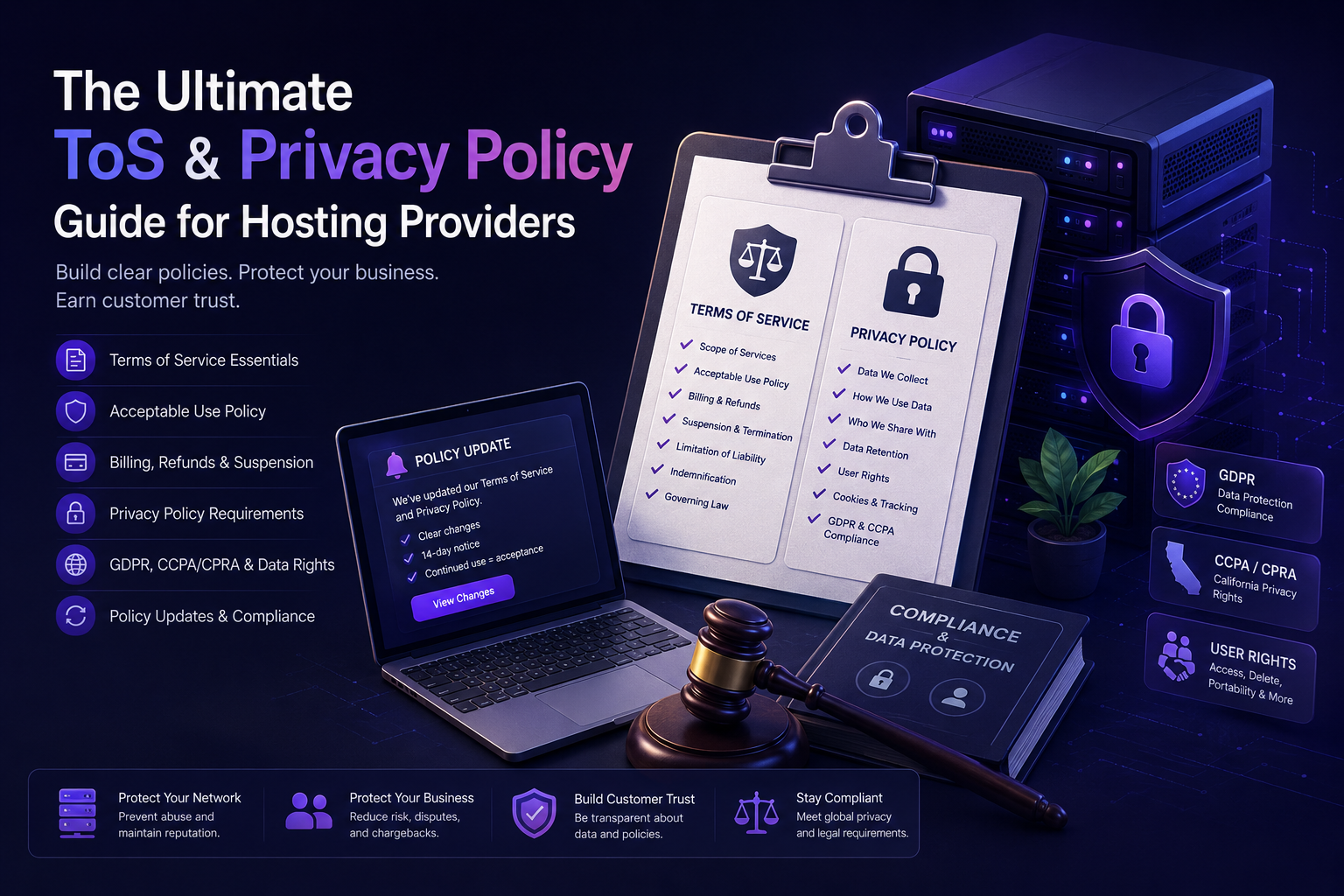
This guide explains the core legal documents hosting providers should understand, including Terms of Service, Acceptable Use Policies, billing rules, privacy policies, GDPR, CCPA/CPRA, data rights, update notices, and basic contract structure.
Terms of Service
Your Terms of Service, often called ToS or Terms, is the contract between your hosting business and your users. It defines the rules, boundaries, responsibilities, and rights for both sides.
If you do not write this clearly, you may as well hang a “Please exploit me” sign on your website.
1. Scope of Services
What it is
A clear explanation of what services your company provides.
What to include
- VPS hosting
- Shared hosting
- Reseller hosting
- Cloud hosting
- Dedicated servers
- Game hosting
- Managed or unmanaged service status
- Support methods and support hours
- Uptime expectations
- What is and is not included in the service
Why it matters
This section sets boundaries. Customers should not be left guessing what they paid for. If backups are not included, say that. If support does not include fixing every broken plugin, say that. If your VPS plans are unmanaged, say that loudly enough for the people in the back.
This also affects liability, customer disputes, and chargeback protection. If a customer claims you failed to provide something, your ToS should make it clear whether that thing was ever included.
We provide unmanaged VPS services with no guaranteed uptime, backup retention, or software support unless otherwise stated in a specific service plan.
2. Acceptable Use Policy
What it is
An Acceptable Use Policy, or AUP, explains how customers are not allowed to use your services.
What to include
- No spam
- No phishing
- No malware
- No botnets
- No illegal content
- No abusive traffic
- No DDoS activity
- No port scanning
- No credential stuffing
- No copyright-infringing content
- No crypto mining unless expressly allowed
- No TOR exit nodes unless expressly permitted
- No open proxies or open relays
- No activity that damages your IP reputation or upstream provider relationships
Why it matters
Your AUP protects your IP reputation, reduces abuse complaints, and helps keep upstream providers happy. It also gives you a clear contractual reason to suspend or terminate problem users.
Hosting providers without an AUP are basically saying, “Please use my network for chaos and make me explain it to my data center later.” Great business plan.
By creating an account or purchasing services, you agree to these Terms of Service, our Acceptable Use Policy, and any service-specific terms shown during checkout.
3. Billing and Refunds
What it is
This section explains payment, renewals, late payments, cancellations, chargebacks, and refunds.
What to include
- Billing cycle, such as monthly, quarterly, annually, or custom
- Whether services renew automatically
- Accepted payment methods
- Invoice due dates
- Grace periods for missed payments
- Suspension timeline after non-payment
- Termination timeline after non-payment
- What happens to customer data after suspension
- What happens to customer data after cancellation
- Refund eligibility
- Whether refunds are prorated
- Non-refundable items
- Chargeback consequences
Why it matters
Misunderstandings about billing and refunds cause a huge amount of customer disputes. Your policy should clearly explain what users are charged for, when they are charged, when refunds are available, and what happens if payment fails.
You also cannot safely assume that “no refunds ever” works everywhere. Regional consumer protection laws may still apply, especially in places like the EU. Your policy needs to be clear and legally realistic, not just aggressive because someone saw another host do it.
Refunds are available within seven days of the initial purchase unless the account has violated our Acceptable Use Policy. After seven days, services are non-refundable unless otherwise required by applicable law.
Services may be suspended if payment is not received by the due date. Suspended services may be terminated and data may be permanently deleted after 14 days of non-payment. We are not responsible for retaining customer data after termination unless required by law.
4. Account Termination and Suspension
What it is
This section explains how and when you can suspend or terminate a user’s service.
What to include
- Grounds for immediate suspension
- Whether warnings are given before suspension
- What violations allow immediate termination
- When customer data is purged
- Whether logs are retained for abuse or legal reasons
- Whether terminated users may create new accounts
- Whether refunds are denied after abuse-related termination
Why it matters
You need to clearly state when and how someone can be removed from your platform. This helps protect you from claims of wrongful termination and gives you authority to act quickly when a customer is causing abuse, legal risk, network damage, or security problems.
It also matters because you need to know when you are allowed to delete their files. “We got tired of them” is not exactly a polished legal policy.
We may suspend or terminate services immediately, with or without prior notice, if we determine that a customer has violated this Agreement, our Acceptable Use Policy, applicable law, third-party rights, or the security or stability of our network. We may retain logs and account records as reasonably necessary for abuse investigation, fraud prevention, legal compliance, or dispute resolution.
5. Updates to the Terms of Service
What it is
This section explains how you can update your Terms of Service and how users will be notified.
What to include
- How users are notified
- How much notice users receive before material changes take effect
- Where the current terms are published
- What counts as acceptance
- Whether continued use means acceptance
- Whether users may cancel if they do not agree
Why it matters
“You agree to whatever changes we make whenever” is not a magic legal spell. Material changes should be announced clearly before they take effect.
Users need a reasonable chance to review changes, disagree, and stop using the service. Otherwise, your updated ToS may be harder to enforce.
We may update these Terms from time to time. If the changes are material, we will notify users at least 14 days prior to the new terms taking effect via email, client area notice, or another reasonable method. Continued use of the services after the effective date will constitute acceptance of the updated Terms.
6. Limitation of Liability
What it is
A limitation of liability clause limits how much customers can sue you for if something goes wrong.
What to include
- Data loss
- Service interruptions
- User error
- Software failure
- Security incidents
- Third-party outages
- Lost profits
- Lost business
- Indirect or consequential damages
- Maximum monetary damages
Why it matters
If a user loses a $50,000 eCommerce database on a tiny hosting plan and tries to sue you for it, this clause is one of your main shields.
It will not always hold up perfectly in every jurisdiction, but it can significantly reduce your exposure.
To the maximum extent permitted by law, we are not liable for indirect, incidental, special, consequential, or punitive damages, including loss of profits, revenue, data, business opportunities, or goodwill. Our total liability for any claim is limited to the amount paid by the customer for the affected service during the 30 days before the claim arose.
7. Indemnification
What it is
Indemnification means the customer agrees to protect you if their use of your service causes legal trouble.
What to include
- Customer agrees to indemnify and hold harmless the company
- Copyright infringement claims
- Illegal content claims
- Spam or abuse complaints
- Network abuse
- Data protection violations caused by the customer
- Claims from third parties harmed by the customer’s activity
Why it matters
If a customer uploads illegal content, sends spam, infringes someone’s copyright, or causes your company to be dragged into a dispute, you should not be paying their legal bills.
Customer agrees to indemnify, defend, and hold harmless the company, its owners, employees, contractors, and affiliates from any claims, damages, losses, liabilities, costs, and expenses, including reasonable attorneys’ fees, arising from the customer’s use of the services, violation of this Agreement, violation of applicable law, or infringement of any third-party rights.
8. Governing Law and Jurisdiction
What it is
This section defines which country, state, or province’s laws apply and where disputes are resolved.
What to include
- Your business location
- Applicable state, province, or country law
- Where lawsuits or disputes must be filed
- Whether arbitration applies
- Whether small claims court is allowed
Why it matters
This helps prevent someone from trying to sue you under a totally unrelated jurisdiction or forcing you into a faraway court.
Choose where your business is based unless your attorney advises otherwise.
This Agreement is governed by the laws of the State of California, United States, without regard to conflict of law principles. Any dispute arising under this Agreement shall be resolved in the state or federal courts located in California, unless otherwise required by applicable law.
Privacy Policy
A Privacy Policy explains what personal data you collect, why you collect it, how you use it, who you share it with, how long you keep it, and what rights users have.
Privacy policies are required or strongly expected under many laws, including GDPR, CCPA/CPRA, PIPEDA, and other international privacy frameworks.
Yes, even small hosts need to care. You may be tiny, but your logs are not magically invisible to privacy law.
9. Identity of the Data Controller
What it is
This identifies who is collecting and controlling the data.
What to include
- Your full company name
- Your legal entity type, such as LLC, corporation, or sole proprietorship
- Your business address or mailing address
- Your privacy contact email
- Data Protection Officer contact, if applicable
- EU or UK representative, if required
Why it matters
Privacy laws require transparency. Users need to know who is responsible for their personal data and how to contact that person or company.
The data controller for this service is Example Hosting LLC, located at [mailing address]. Privacy-related requests may be sent to privacy@example.com.
10. What Data You Collect
What to include
- Email address
- Username
- Name
- Billing address
- Phone number, if collected
- IP address
- Login history
- Support ticket content
- Abuse report content
- Payment records
- Invoice records
- Tax records
- Fraud screening data
- Session cookies
- Analytics cookies
- HTTP logs
- System logs
- SSH logs, if applicable
- Control panel logs
- Backup metadata
Why it matters
If it can identify a person, directly or indirectly, treat it as personal data. This can include IP addresses, login records, support tickets, invoices, and logs.
Not disclosing what you collect can create privacy compliance problems under GDPR, CCPA, and other privacy laws.
We collect account information such as name, email address, username, billing details, IP addresses, service identifiers, support communications, payment records, and technical logs necessary to provide, secure, and maintain our services.
11. Why You Collect Data
What it is
This section explains why you collect each type of personal data and, where required, the legal basis for doing so.
Common reasons
- Providing the service: account data, server data, login data, and IP data
- Billing and tax compliance: names, billing addresses, invoices, and payment records
- Fraud prevention: IP addresses, device details, and payment risk signals
- Abuse prevention: logs, reports, network data, and account history
- Support: ticket contents and account details
- Analytics: usage data and cookies, depending on consent requirements
- Marketing: email and preferences, depending on consent and region
Legal basis examples
- Contract: needed to provide the service the customer purchased
- Legal obligation: required for tax, accounting, or lawful requests
- Legitimate interest: fraud prevention, abuse prevention, and network security
- Consent: optional analytics, marketing, or non-essential cookies where required
Why it matters
GDPR requires you to explain the legal basis for processing personal data. Even outside the GDPR, this section helps users understand why you are collecting information in the first place.
We process personal data to provide services under our contract with you, comply with legal obligations, prevent fraud and abuse, secure our network, respond to support requests, and improve our services. Where required, we rely on your consent for optional processing such as certain analytics or marketing communications.
12. Who You Share Data With
What to include
- Payment processors
- Fraud prevention providers
- Domain registrars
- License providers
- Data center providers
- Cloud infrastructure providers
- Backup providers
- Email delivery providers
- Analytics platforms
- Customer support tools
- Abuse handling partners
- Legal or regulatory authorities
- Law enforcement, when legally required
Why it matters
A data processor or service provider is any third party that touches customer data on your behalf. You are generally required to disclose these categories of third parties in your Privacy Policy.
We may share personal data with service providers that help us operate our business, including payment processors, fraud prevention providers, data centers, infrastructure providers, email providers, analytics providers, and support tools. We may also disclose data where required by law, legal process, or abuse investigation.
13. Data Retention
What to include
- How long account records are kept
- How long billing records are kept
- How long invoices are kept
- How long support tickets are kept
- How long abuse reports are kept
- How long login logs are kept
- How long HTTP logs are kept
- How long system logs are kept
- How long backups are retained
- When deleted account data is removed
Why it matters
You are required under privacy laws like GDPR to minimize data storage and explain how long personal data is retained.
“Forever because we never built a cleanup process” is not a data retention policy. It is a future headache wearing a fake mustache.
Example retention structure
- Account data: kept while the account is active
- Billing records: kept as required for tax and accounting obligations
- Support tickets: kept for a defined support and dispute period
- Abuse reports: kept as needed for security, legal, and fraud prevention
- Server logs: kept for a defined period unless needed for investigation
- Backups: rotated on a defined schedule
- Deleted accounts: removed within a defined period unless retention is legally required
We retain personal data only as long as necessary for the purposes described in this Policy, including providing services, resolving disputes, preventing fraud or abuse, maintaining security, and complying with legal obligations. Retention periods vary depending on the type of data and applicable legal requirements.
14. User Rights
Privacy laws give users rights over their personal data. Which rights apply depends on the user’s location and the laws that apply to your business.
Users may be able to request
- Access to their personal data
- Correction of inaccurate personal data
- Deletion of personal data
- Restriction of processing
- Objection to processing
- Data portability
- Withdrawal of consent
- Opt-out of marketing
- Information about data sharing
- Filing a complaint with a privacy authority
GDPR rights
Users in the EU and UK may have rights to access, correct, delete, restrict, object, transfer, and withdraw consent regarding their personal data.
CCPA/CPRA rights
California users may have rights to know what personal information is collected, access it, delete it, correct it, opt out of sale or sharing, limit certain uses of sensitive personal information, and avoid discrimination for exercising privacy rights.
PIPEDA rights
Canadian privacy law may apply to businesses collecting, using, or disclosing personal information in commercial activity. If you serve Canadian users, review PIPEDA and any applicable provincial privacy laws.
Why it matters
Ignoring or delaying valid data rights requests can create legal risk. Your Privacy Policy should tell users what rights they may have and how to submit requests.
Depending on your location, you may have the right to request access to your personal data, correction of inaccurate data, deletion of data, restriction or objection to processing, portability of data, withdrawal of consent, or information about how your data is shared. You may submit privacy requests by contacting privacy@example.com.
15. Cookies and Tracking
What to include
- Session cookies
- Login cookies
- Security cookies
- Preference cookies
- Analytics cookies
- Advertising cookies, if any
- Third-party tracking tools
- Cookie duration
- How users can manage cookie preferences
Why it matters
Cookie consent is no longer something you can brush off with “by using our site, you accept.” In many places, especially Europe, non-essential cookies usually require clear consent before they are placed.
Required cookies for login and security are different from optional analytics or advertising cookies. Do not mix those together and call it a day. Regulators do, unfortunately, own reading glasses.
We use cookies necessary for authentication, security, account management, and service functionality. We may also use optional analytics cookies to understand site usage. Where required by law, we request consent before placing non-essential cookies and provide a way to manage cookie preferences.
16. CCPA/CPRA-Specific Requirements
Important note
CCPA/CPRA does not automatically apply to every tiny business. It generally applies to covered businesses that meet certain thresholds, such as revenue, volume of California consumer data, or revenue from selling or sharing personal information.
That said, if you serve California users, you should understand the requirements instead of waiting for a complaint to become your compliance education plan.
California users may require
- Access to collected personal information
- A way to request deletion
- A way to request correction
- An opt-out of sale or sharing, if applicable
- A “Do Not Sell or Share My Personal Information” link, if applicable
- Disclosure of categories of personal information collected
- Disclosure of categories of sources
- Disclosure of business or commercial purposes
- Disclosure of categories of third parties receiving personal information
- Disclosure of financial incentives, if applicable
Why it matters
CCPA/CPRA can be enforced with fines and investigations. You do not need to be located in California for California privacy requirements to become relevant if you serve California residents and meet the applicable thresholds.
We do not sell personal information for money. However, some privacy laws define “sale” or “sharing” broadly. Where applicable, California residents may opt out of the sale or sharing of personal information by using our privacy request form or contacting privacy@example.com.
Updating Policies
Policies are not “set it and forget it.” If your services, billing, support, data collection, providers, or legal obligations change, your policies may need updates too.
17. Terms of Service Updates
Do
- Notify users at least 14 days before material changes take effect
- Make a changelog or summary of what changed
- Include an effective date on the document
- Allow users to cancel if they do not agree
- Use email or client area notices for important updates
- Archive previous versions internally
Why it matters
Users need a fair chance to review changes and disagree. If they do not, your changes may be harder to enforce.
We updated our Terms of Service effective June 1, 2026. The changes clarify our Acceptable Use Policy, billing grace periods, suspension procedures, and data retention rules. Continued use of the services after the effective date means you accept the updated Terms.
18. Privacy Policy Updates
Do
- Highlight material changes
- Update the “Last Modified” date
- Email customers if you change how you collect data
- Email customers if you change how you share data
- Get new consent where legally required
- Keep previous versions for your records
Why it matters
Transparency is legally required. If you change what data you collect, why you collect it, who you share it with, or how long you keep it, users may need to be told clearly.
Do not silently change privacy practices and hope no one notices. That is not compliance. That is a future screenshot in someone’s complaint.
Tools You Can Use
These tools can help generate policy drafts, cookie banners, and compliance documents. They are not a substitute for a lawyer, but they are better than copying another host’s terms and praying.
- Termly.io: GDPR and CCPA templates, privacy policies, Terms of Service, and cookie banners.
- Iubenda.com: Privacy policy, cookie policy, and compliance tools for international businesses.
- PrivacyPolicies.com: Free and premium templates for privacy policies, terms, disclaimers, and cookies.
- GDPR.eu: Helpful resource for EU-focused GDPR information.
- CPPA.CA.GOV: Official California Privacy Protection Agency information for CCPA/CPRA.
- California Attorney General CCPA page: Official CCPA information for California privacy rights.
- Office of the Privacy Commissioner of Canada: Official PIPEDA and Canadian privacy guidance.
Hosting Provider Legal Checklist
Terms of Service checklist
- Services are clearly defined
- Managed vs unmanaged support is explained
- Uptime expectations are stated
- Backup responsibilities are stated
- AUP is included or linked
- Billing cycles are explained
- Refund policy is clear
- Chargeback rules are included
- Suspension rules are included
- Termination rules are included
- Data deletion timeline is included
- ToS update procedure is included
- Liability is limited
- Indemnification is included
- Governing law is included
- Dispute venue is included
Privacy Policy checklist
- Controller identity is listed
- Contact email is listed
- Data categories are disclosed
- Collection purposes are disclosed
- Legal bases are explained where needed
- Third-party processors are disclosed
- Retention periods are described
- User rights are explained
- Cookie usage is explained
- Cookie consent is handled where required
- GDPR rights are addressed
- CCPA/CPRA rights are addressed if applicable
- PIPEDA obligations are considered if serving Canada
- Policy update process is explained
- Last modified date is visible
Common Mistakes Small Hosts Make
1. Copying another provider’s ToS
Besides being lazy, this can leave you with clauses that do not match your company, jurisdiction, billing model, service type, or actual practices.
2. Saying backups are not your problem while advertising “secure hosting”
Be precise. If backups are not included, say so clearly. If they are included, explain the retention period and limitations.
3. Having no abuse policy
This is how you lose upstream trust, IP reputation, and your will to live.
4. Forgetting logs are personal data
IP addresses, login records, abuse logs, support tickets, and billing records may all contain personal data.
5. Keeping data forever
“Storage is cheap” is not a privacy strategy. Define retention periods and follow them.
6. Not explaining refund limits
Refund drama is predictable. Write the policy before the angry ticket arrives.
7. Updating terms silently
Material changes should be announced. Sneaky changes are not cute, and courts are rarely impressed by “we edited the page at midnight.”
8. Assuming CCPA does not matter because you are not in California
CCPA/CPRA can apply based on serving California residents and meeting statutory thresholds, not simply where your company is located.
9. Using Discord as your only legal notice system
Discord is useful. It is not your legal backbone. Use email and client area notices for important policy changes.
10. Not matching your documents to your actual operations
Your Privacy Policy must describe what you really do. If your policy says you do not use analytics but you installed three trackers and a marketing pixel, congratulations, you created evidence.
Final Thoughts
A good Terms of Service and Privacy Policy will not make your hosting business magically immune to legal problems. What they can do is define expectations, reduce disputes, support abuse enforcement, explain your data practices, and give you a stronger position when something inevitably goes sideways.
For small hosts, this is not about pretending to be a giant corporation. It is about not running a public infrastructure business with legal documents held together by vibes, duct tape, and a copied paragraph from 2014.
Disclaimer
This guide is provided for informational purposes only and is intended to help small and new hosting providers better understand their legal responsibilities when drafting Terms of Service and Privacy Policies.
This guide does not constitute legal advice, legal representation, or an attorney-client relationship. Laws vary by country, state, province, customer location, business structure, service type, and data handling practices.
You should consult a qualified attorney before publishing or relying on legal documents for your hosting business.